SODA Features
Introduction
SODA is a Structural Optimization, Design and Analysis computer program for use by structural engineers. The program has been developed over many years by a research group in the Civil Engineering Department of the University of Waterloo, Canada, in conjunction with a broad base of practising engineers throughout North America to ensure that the program meets the practical needs of the structural engineering community.
Besides having the capabilities to perform verification (Code checking) and analysis, SODA has the capability to automatically design least-weight steel frameworks under static loads. The user need only input data concerning the structural geometry, member properties and loading conditions. SODA will automatically select the members from a database of standard sections so as to minimize the weight of the entire structure, while satisfying all design code requirements for strength and displacement. In other words, a steel design generated by SODA is feasible, of least-weight and completed in a single computer run.
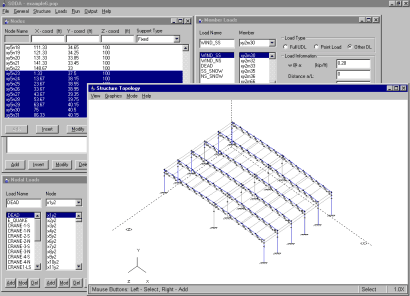
In addition to its unique design capability, SODA features a windowing user interface that speeds both data entry and editing. The user interface has been developed in the Microsoft Windows environment. Information is quickly entered in a spreadsheet format using both the keyboard and a mouse. All data fields are clearly labelled, with all options visible to the user. Movement through the data screens is expedited by drop-down menus. An on-line help facility can be instantly accessed with a single keystroke.
SODA provides a printable graphics display view of the structure on the screen. A zoom and pan capability allows the user to magnify the display of any part of the structure. A rotate-display capability permits the structure to be viewed from any angle. The loading on the structure may be viewed graphically as well as the deflected shape and member shear force, bending moment and deformation diagrams.
Click on the picture to enlarge
New for version 3.5
SODA features a faster 32-bit interface that takes full advantage of the Windows 95/98/NT/ME/2000/XP environment. This new version also includes:
- Improved graphical interface for reviewing structure topology through point and click interaction with the screen.
- Improved graphical interface for creating structure loading data, including the facility to create load data through point and click interaction with the screen.
- Optimization of various internal data-handling routines to further enhance computational and graphical features.

SODA is a software program that can be used to analyze and design structural steel frameworks in accord with both U.S. and Canadian design codes and commercial-standard sections.
- Analysis: 2D or 3D, first order or P-Delta
- Optimization: Automatic Least-Weight Design
- Design for:
- AISC Allowable Stress Design (ASD) 9th Edition
- AISC Load and Resistance Factor Design (LRFD) 2nd Edition
- CSA-S16.1-M94 Limit States Design of Steel Structures (LSD)
- Both stresses and deflections can be controlled for design
- Tension-only or Compression-only members
Underlying Theory
The SODA design process involves the co-ordinated use of elastic structural analysis, first-order sensitivity analysis and a continuous/discrete optimization technique. For the initial 'trial" design of the structure, which is automatically selected by SODA, structural and sensitivity analyses are conducted and the strength and displacement design conditions are formulated explicitly in terms of member cross-section sizes through the use of first-order Taylor's series. The structure weight function is formulated in terms of member sizes. The optimization technique is applied to minimize the weight function, subject to the constraints imposed by the design conditions, so as to achieve an improved (lower weight) design of the structure. The weight optimization problem is reformulated for the new design and the process is repeated until the weight of the structure converges to a minimum after a number of design stages.
The iterative design process has two phases. The first phase involves a few design stages in which member sizes are taken as continuous variables to the weight optimization so as to quickly establish a reasonably well proportioned structure. The second phase involves taking standard section sizes as discrete variables to the weight optimization. The results of the first phase are used to select an "initial" standard section for each member of the structure to commence the second design phase. Selected at the same time from the section database for each member is an "initial" set of standard sections from which the design of the member is to be chosen during the first weight optimization of the second phase. The discrete-variable optimization phase is conducted for a number of design stages until, while satisfying all strength and displacement conditions, the standard section sizes found for the members correspond to minimum structure weight.
The SODA design process is remarkably efficient. The number of iterations required to achieve the optimized design is generally small and almost totally independent of the complexity of the structure.
The structural and sensitivity analysis routines employed by SODA are based upon the conventional Displacement Method of analysis for elastic material behaviour.